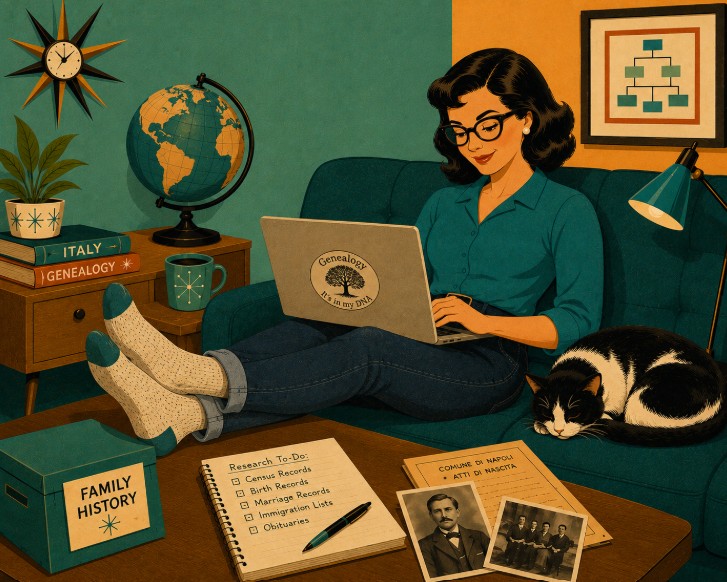
When I give a webinar, much of the time I’m teaching a specific computer tool or a specific function within a larger tool. Some of my more popular webinars cover things like translating documents using AI or using Google Maps for genealogy. But in practice, I usually use a bunch of tools together (or at least in quick succession) to further my research. Knowing how and when to use those tools together is a skill in itself.
This past weekend was a good example. A few years ago, I was given a family bible that contained a treasure trove of old documents, newspaper clippings and other ephemera. One item I hadn’t investigated was a 1918 church document confirming the 1888 marriage of my paternal great-grandparents in Italy. While I know quite a bit about my great-grandmother, Anna Angeloro, I know very little about my great-grandfather, Ferdinando D’Urso, and his family.
On Saturday, I sat down to see where this one document would take me.
First, I needed an English translation, so I opened ChatGPT. I had it transcribe the original document and then translate it. The translation confirmed the basics—the date and place of the marriage, the names of the bride and groom, their parents and the witnesses. It also told me that this was a 1918 extract of the original 1888 church record and even identified where that record could be found in the parish register.

Then I got sidetracked. In genealogy, sidetracks can be half the fun.
I always enjoy seeing the places where my ancestors lived, so I went to Google Maps and searched for the church named in the document, San Cesareo Martire in Cava de’ Tirreni. A few clicks later, I was in Street View, looking up at the church from the same street my great-grandmother may have walked down for her wedding. Athough the church had been rebuilt in 1932, I could imagine that the view was the same.
I noticed several commemorative plaques on the outside of the church and took screenshots. Back in ChatGPT, I uploaded the images and asked for translations. Some turned out to be memorials to local servicemen. Another commemorated the rebuilding of the church and named the parish priest, Don Luigi Fiorillo, the same priest who had certified my great-grandparents’ marriage extract in 1918. None of this added a new branch to my family tree, but it added context to their story.
Now it was time to track down the civil marriage record.
For that, I went to the Italian genealogy behemoth Portale Antenati (Ancestors Portal), a website hosted by the Italian government with millions of digitized civil records. Although many Italian records can also be found through FamilySearch, some of the images I need there are restricted and require a visit to a FamilySearch Center or affiliate library. With Portale Antenati, I could continue searching without leaving my couch.
The Antenati website is in Italian, so I used the Google Translate extension in my Chrome browser. It lets me translate pages on the fly without leaving the original website—a small tool, but a very useful one.
After some digging through the records, I found the complete 1888 civil marriage act. I saved images of the record and brought them back to ChatGPT for transcription and translation.
The civil record confirmed Ferdinando’s parents as Francesco D’Urso and Maria Griscuolo. Those same names appear on Ferdinando’s New York City death certificate, so finding them independently in his Italian marriage record was excellent corroborating evidence. Even better, the marriage record gave me information I didn’t have before. Ferdinando was 34 years old, worked as a sailor and was born in Vietri sul Mare. Anna was 22, a weaver, and was born in San Cesareo. Wikipedia, while perhaps not up to Genealogical Proof Standard, was fine for a basic hsitorical overview.
With Ferdinando’s parents’ names confirmed, I switched tools again.
This time I went back to FamilySearch to look for more records of the D’Urso family. One trick I sometimes use is to conduct a broad search using just the names of a mother and father, along with a general location. It can be more effective than you might expect. The combination of two parents’ names and a place can narrow the possibilities considerably.
I didn’t find Ferdinando, but I did find what may be an excellent lead on one of his sisters.
FamilySearch has a link to her marriage record from the year before my great-grandparents married. Unfortunately, I can’t view the image from home, and so far my attempts to locate the same record on Antenati have been unsuccessful.
So I used one final tool: a plain old Chrome bookmark.
I have a folder specifically for records I need to view the next time I visit a FamilySearch Center or affiliate library. I added this one to the folder. When I get there, I can open the folder and work through the saved records one by one. It’s quick, easy and keeps me from forgetting what I wanted to find.
And that’s where this particular research session ended. Not with an answer, but with a new lead waiting for my next library trip.
What started with one old piece of paper took me through ChatGPT, Google Maps & Street View, Google Translate, Portale Antenati, and FamilySearch. No single tool did the research for me. Each one helped with a different part of the puzzle, and the information I found with one tool helped me decide which tool to use next.
That, to me, is one of the most useful technology skills a genealogist can develop: not simply knowing how to use individual tools, but knowing how to make them work together.